


You probably use a full stop dozens of times every day without thinking about it. And most of the time, you get it right. But here’s the thing — this tiny dot is responsible for more writing errors than almost any other punctuation mark. Run-on sentences, comma splices, sentence fragments — they all trace back to one missed or misplaced full stop.
Whether you’re writing an essay, drafting a work email, or just trying to understand why your grammar teacher kept circling things in red, this guide has you covered. We’ll walk through everything: what a full stop actually is, all the contexts where you use one, the rules that trip people up, and how the digital age has quietly changed the way we think about this punctuation mark.
What Is Full Stop Punctuation?

A full stop is the punctuation mark represented by a single dot (.) placed at the baseline of a line of text. In British English, it’s called a full stop. In American English, it’s called a period. Same symbol, same rules — just different names depending on which side of the Atlantic you learned to write.
Its name has roots in Latin. The phrase plenus punctus — meaning “full point” — gave rise to the modern term. Historically, scribes in ancient Greek and Latin manuscripts used dots at varying heights to signal different lengths of pause. A high dot signalled a complete stop; a middle dot was like a modern semicolon; a low dot served as a comma. Over centuries, it was the low dot that survived and moved to the baseline, becoming the full stop we know today.
Here’s the simplest definition you need: a full stop marks the end of a complete sentence that is a statement or a command.
That’s the core job. But as you’ll see, it shows up in a few other places too.
When to Use a Full Stop: The 7 Key Rules
1. At the End of a Declarative Sentence

This is the primary use. A declarative sentence makes a statement — it asserts something as a fact or opinion. It doesn’t ask a question, and it doesn’t express strong emotion. It just states.
- She left the office at six.
- The experiment produced unexpected results.
- London is the capital of England.
Straightforward. Every statement ends with a full stop.
2. At the End of an Imperative Sentence
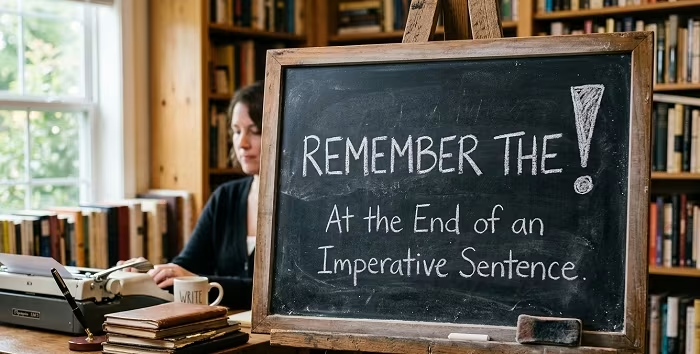
An imperative sentence gives a command or makes a request. These often don’t have an explicit subject — the “you” is implied.
- Close the door.
- Please send me the report by Thursday.
- Turn left at the junction.
Notice that commands don’t require an exclamation mark unless you want to convey urgency or strong emotion. A plain instruction just needs a full stop.
3. After Indirect Questions

This one surprises a lot of people. An indirect question — one that reports a question rather than asking it directly — ends with a full stop, not a question mark.
- She asked whether the meeting had been rescheduled. ✓
- She asked whether the meeting had been rescheduled? ✗
- I wondered if he’d arrived yet. ✓
The test is simple: if the sentence is making a statement about a question rather than posing the question itself, it ends with a full stop.
Also Read: pinbumgisxif model expensive
4. After Abbreviations (with caveats)

Full stops are used after many abbreviations — but the rules differ between British and American English.
| Context | British English | American English |
|---|---|---|
| Titles (Doctor) | Dr Jones | Dr. Jones |
| Contractions (Mister) | Mr Smith | Mr. Smith |
| Latin abbreviations | e.g., i.e., etc. | e.g., i.e., etc. |
| Acronyms (NATO) | NATO | NATO |
| Initialisms (UK) | UK | U.K. (becoming less common) |
Key rule: If a sentence ends with an abbreviation that already has a full stop, you don’t add another. One dot does the work.
- Please submit all forms to H.R. ✓ (not H.R..)
5. In Decimal Numbers and Web Addresses
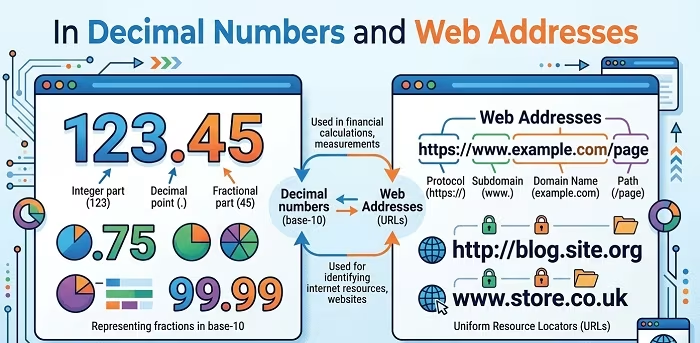
The full stop doubles as a decimal point in numbers (3.14, £9.99) and separates domains in web addresses (www.example.com). In these contexts, you’d pronounce it as “dot” rather than “full stop.”
6. As Part of an Ellipsis
Three full stops in a row (…) form an ellipsis, used to indicate omitted words in a quotation or a trailing off in speech. The individual dots aren’t functioning as sentence-ending stops here — they work together as a single punctuation unit.
7. In Some List Items
If your bullet points or numbered list items are complete sentences, each one should end with a full stop. If they’re fragments (short phrases or single words), they generally don’t need one. Be consistent — pick one approach and stick with it throughout your list.
When NOT to Use a Full Stop

Just as important as knowing when to use it is knowing when to leave it out.
Don’t use a full stop after:
- Question marks or exclamation marks — they already end the sentence
- Headings and titles (including this article’s headings)
- The last item in a list of short fragments (inconsistency looks messy)
- Incomplete sentences used stylistically — though use these sparingly in formal writing
And here’s something many writers get wrong: never follow a full stop with another full stop, even if the sentence ends with an abbreviation. One is enough.
Full Stop vs. Comma: The Most Common Mistake in Writing
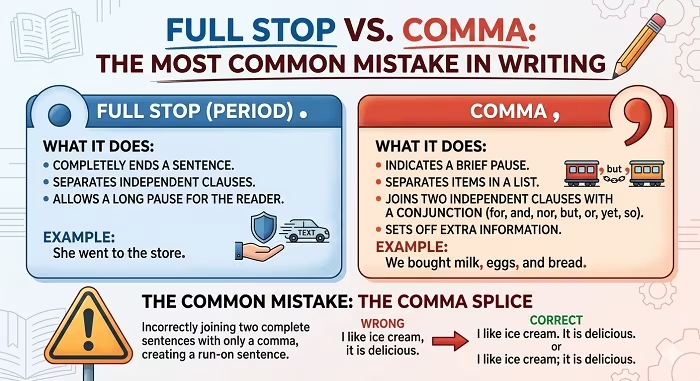
Swap a full stop for a comma between two independent clauses and you’ve created what’s called a comma splice — one of the most frequent errors in academic and professional writing.
Comma splice (incorrect): She finished the assignment, she submitted it online.
Correct versions: She finished the assignment. She submitted it online. She finished the assignment, and she submitted it online. She finished the assignment; she submitted it online.
All three fixes work. The simplest is usually the full stop. The sentence-joining approach with and works when the ideas are closely linked. The semicolon is elegant but best reserved for when you want to signal a tight relationship between two thoughts.
The reverse error — using a full stop where a comma belongs — creates a sentence fragment. This is when a clause that depends on another is cut off and left stranded.
Fragment (incorrect): Although the report was detailed. It failed to address the main issue.
The first clause can’t stand alone. It needs the second one to complete its meaning. Remove the full stop, replace it with a comma, and you’re fine.
The Two-Space Debate: One Space or Two After a Full Stop?
If you were taught to type in the 1980s or 90s, you probably learned to put two spaces after a full stop. That rule came from the era of typewriters, which used monospaced fonts — fonts where every character took up the same amount of horizontal space. The extra gap made text easier to parse.
Modern word processors and digital typography handle spacing automatically. The double-space habit is now considered outdated, and most current style guides — including the Chicago Manual of Style and APA — recommend a single space after a full stop. If you’re still hitting the spacebar twice out of habit, it’s worth breaking.
Full Stops in Quotation Marks: British vs. American Rules

This is another area where British and American English part ways.
American English: The full stop goes inside the closing quotation mark, always. She said, “I’ll be there by noon.” He described it as “unprecedented.”
British English: The full stop goes outside the closing quotation mark when the quoted material is only part of the sentence. She described the event as “a turning point”. But: He said, “I’ll call you tomorrow.” (when the quote is a complete sentence, the full stop stays inside)
Neither system is more logical than the other — they’re just conventions. The key is consistency within a single piece of writing.
Also Read: spanish words that start with i and their meaning
Full Stops in the Digital Age: Texting, Emails, and Social Media
Here’s where things get genuinely interesting. The full stop has taken on a second life in digital communication — and not always as a neutral grammar tool.
Research from Binghamton University found that text messages ending with a full stop were perceived as less sincere or even passive-aggressive compared to messages without one. The logic is subtle: in texting, hitting “send” already signals the end of a message. A full stop on top of that starts to feel deliberate, cold, or loaded.
Think about the difference:
- “Sounds good” — casual, warm, fine
- “Sounds good.” — suddenly feels flat, possibly terse
Context matters enormously here. The same rules don’t apply across different formats:
| Format | Full Stop Usage |
|---|---|
| Academic essays | Always required |
| Business emails | Standard and expected |
| Formal reports | Always required |
| Casual text messages | Optional; can read as cold |
| Social media captions | Often omitted at end of post |
| Email subject lines | Generally omitted |
| Headings/titles | Not used |
The takeaway: full stops are non-negotiable in formal writing. In informal digital communication, read the room.
Common Full Stop Mistakes and How to Fix Them
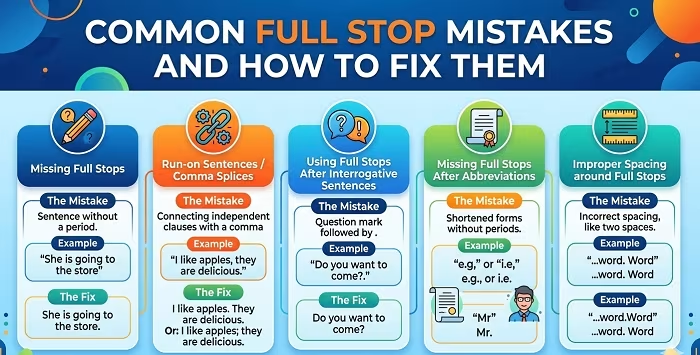
Let’s run through the errors that come up most often:
1. Run-on sentence Two complete thoughts mashed together without proper punctuation. The weather was terrible we decided to stay home. ✓ The weather was terrible. We decided to stay home.
2. Comma splice Two independent clauses joined only by a comma (see above).
3. Sentence fragment A dependent clause or phrase treated as a complete sentence. Because she was tired. ✓ Because she was tired, she went to bed early.
4. Double punctuation Never stack a full stop on another terminal mark. She asked if he was ready?. or We arrived at 5 p.m.. ✓ She asked if he was ready. / We arrived at 5 p.m.
5. Missing capital letter after a full stop The word following a full stop should start with a capital letter. She left the room. he didn’t follow. ✓ She left the room. He didn’t follow.
6. Two spaces after a full stop One space is the modern standard.
Full Stop vs. Other Terminal Punctuation
Not every sentence ends with a full stop. Here’s a quick breakdown of when to choose between the three terminal marks:
| Sentence Type | Example | Ends With |
|---|---|---|
| Statement | The train leaves at nine. | Full stop (.) |
| Genuine question | When does the train leave? | Question mark (?) |
| Exclamation/strong command | Get out of here! | Exclamation mark (!) |
| Mild command | Please sit down. | Full stop (.) |
| Indirect question | She wondered when it would end. | Full stop (.) |
One practical note: exclamation marks should be used sparingly. Overusing them drains them of impact and can make writing feel breathless or unprofessional. A well-placed full stop after a short, punchy sentence often carries more weight than an exclamation mark would.
Also Read: Preppy lorax
Full Stop Punctuation in Academic Writing

If there’s one context where full stops are most misused, it’s academic essays. The two big problems:
Too few full stops — resulting in long, unwieldy sentences that try to carry too many ideas at once. Many students assume longer sentences signal more sophisticated thinking. They don’t. Clarity does.
Too many full stops in the wrong places — breaking up sentences that should flow together, or turning dependent clauses into fragments.
A useful test: read your paragraph aloud. Natural pauses where you need to breathe are usually where full stops belong. If you’re running out of air halfway through a sentence, it’s probably too long.
Quick Reference: Full Stop Rules at a Glance
| Use a full stop… | Don’t use a full stop… |
|---|---|
| After declarative sentences | After question marks or exclamation marks |
| After imperative sentences (commands) | In headings and titles |
| After indirect questions | When a comma, semicolon, or colon is more appropriate |
| After many abbreviations | After a second sentence if it already ends with a full stop |
| As a decimal point in numbers | In email subject lines |
FAQ: Full Stop Punctuation
What is a full stop in grammar? A full stop is a punctuation mark (.) used to signal the end of a complete sentence that makes a statement or gives a command. It’s also used in abbreviations and decimal numbers.
Is a full stop the same as a period? Yes — completely. “Full stop” is the British English term; “period” is the American English equivalent. Both refer to the same symbol with identical functions.
Should you put a full stop after a question mark? No. A question mark already ends the sentence. Adding a full stop after it is incorrect.
Do you put a full stop after a URL or email address? This can get awkward. If a URL appears at the end of a sentence, technically the full stop belongs there — but in practice, many writers restructure the sentence to avoid ambiguity, placing the URL mid-sentence or on its own line.
Why does a full stop feel rude in texts? Research suggests that because text messages are an inherently casual format, adding a full stop feels deliberately formal — almost cold or clipped. The line break when you hit “send” already implies the end of a thought, so the dot can come across as abrupt or passive-aggressive in informal contexts.
How many spaces after a full stop? One. Modern style guides recommend a single space. Two spaces is an outdated practice from the typewriter era.
Can you start a sentence with “And” or “But” after a full stop? Yes. Starting a sentence with a coordinating conjunction is perfectly acceptable in modern English, both informally and in most formal contexts. Some traditional style guides discourage it, but the rule against it has largely been abandoned.
What’s the difference between a full stop and a comma? A full stop ends a sentence; a comma creates a pause within one. Using a comma where a full stop belongs is called a comma splice — a very common error in both student and professional writing.
Conclusion
The full stop is one of those things you barely notice when it’s used correctly — and can’t stop noticing when it isn’t. It does a deceptively important job: it tells readers when one thought ends and another begins. Without it, or with it misplaced, writing loses its rhythm, clarity, and authority.
The core rules aren’t complicated. End your statements and commands with a full stop. Don’t confuse it with a comma. Know that indirect questions get a full stop, not a question mark. Understand that British and American conventions differ slightly around abbreviations and quotation marks. And if you’re texting, know that context shapes how that little dot lands.
Master those basics, and you’ve genuinely mastered one of the most used punctuation marks in the English language.