

Afternoon thunderstorms and hurricanes don’t pause payroll. Your POS, cloud backups, and Zoom calls must keep humming or revenue stops. Yet most “best ISP” lists recycle marketing copy—headline speeds, teaser prices—while hiding modem fees, lock-ins, and last Saturday’s eight-hour outage.
So we audited Florida carriers. Over four weeks we parsed contracts, state grants, Reddit rants, and uptime logs, then scored each on cost, reliability, uploads, terms, support, and perks like LTE fail-over.
Below, you’ll find the five providers that stretch every dollar and stay online through storm season—plus tactics to cut your bill.
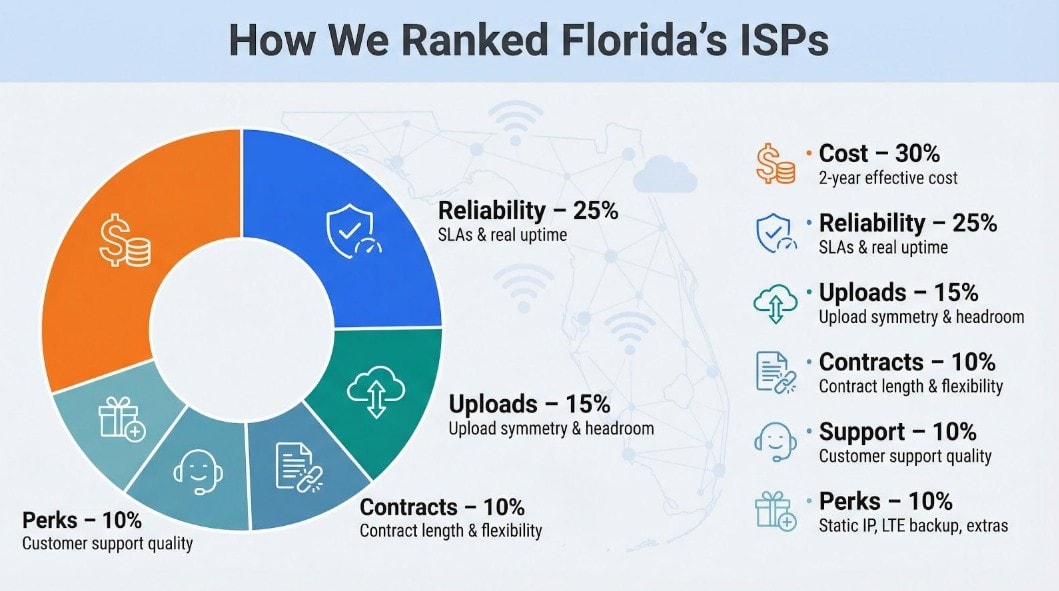
How we ranked Florida’s ISPs
You deserve more than a random top-five list, so we built a scorecard that mirrors the questions every owner asks when the bill arrives.
First, we calculated the two-year effective cost for each entry plan. Intro prices mean little if month 13 doubles your bill, so we added the year-two bump, modem fees, and any contract penalties. This figure carries the most weight at thirty percent of the total score because cash flow matters most.
Next comes reliability. We reviewed published SLAs and independent uptime data, then deducted points when a provider lacked automatic fail-over or drew frequent storm-season complaints. Reliability counts for twenty-five percent. Nine “nines” in a press release do not impress if Reddit threads report weekly drops.
Upload symmetry and headroom earn fifteen percent. Cloud backups, security cameras, and Teams meetings hit the upstream hard. Fiber providers start strong here; cable rivals gain partial credit if they have a documented DOCSIS 4.0 rollout on the calendar.
Contract flexibility matters, so we assign ten percent to no-contract or short-term offers. Long lock-ins with steep exit fees lose points quickly.
Customer support quality also carries ten percent. J.D. Power awards, 24/7 local help desks, and short hold times lift scores. Endless phone trees and “we will get back to you in three business days” drag them down.
The final ten percent rewards true business perks such as static IPs, bundled LTE backup, security software, or free modems. If an add-on saves money or reduces downtime, it counts.
We normalized every category to a ten-point scale, ran the numbers, and let the totals decide the podium. No secret sauce, no pay-to-play, just clear criteria you can reuse when a rep claims to have “the best deal ever.”
1. Wow! Business: Central Florida’s fiber value leader
WOW! Business small business internet plans screenshot for Florida fiber value
Overview and why it tops the list
WOW! rebuilt its Florida network from the ground up, replacing legacy coax with buried fiber that shrugs off summer lightning. The upgrade delivers two wins: symmetrical uploads that keep cloud backups moving and a written 99.9 percent uptime promise with bill credits if the line slips below target (drivers lose about 17 hours each year). Each tier also includes 24/7 U.S.-based support and flexible small business internet plans that let owners add wireless backup or whole-business WiFi only if they need it.
Price closes the argument. According to World Business Outlook, a 600 Mbps fiber plan costs about $1,650 all-in over two years—roughly $1,200 less than Comcast’s comparable tier once you add modem rent and year-two bumps. For many small businesses, that savings buys a battery backup or a 5G fail-over router.
Combine solid reliability with budget-friendly math and you get the best dollar-per-nine value in the state. That is why WOW! sits at number one on our scorecard.
2. Spectrum Business: no-contract coverage across most of Florida

Spectrum Business no-contract internet plans screenshot for Florida small businesses
Why it ranks runner-up
Walk down almost any main street from Jacksonville to Naples and a Spectrum pedestal is within sight. That reach solves half the battle: you can get installed in days, not weeks, and add new storefronts to the same bill with a quick call.
Spectrum earns loyalty through simplicity. Plans start near $65 for 500 × 20 Mbps, the modem is free, data is unlimited, and you can cancel at any time. No early-termination math, no “we own your soul until 2029” fine print. For owners who dread paperwork, that freedom feels fresh.
Reliability holds steady. Spectrum targets about 99.9 percent uptime and pairs each coax gateway with crews that stage generators before hurricanes hit. Choose the Invincible WiFi router and a built-in 5G radio plus eight-hour battery keeps credit-card machines alive when the pole outside loses power.
Uploads remain the one speed bump. Cable architecture caps upstream near 35 Mbps today. That works for point-of-sale data and email but pinches if you push large design files to the cloud. Spectrum promises multi-gig symmetrical service once DOCSIS 4.0 goes statewide, yet the calendar still shows “coming soon.”
Combine solid download speed, statewide crews, and a zero-contract promise and you have Florida’s most approachable business ISP. If fiber is not on your block and you refuse a three-year leash, Spectrum is the easy second-place pick.
3. AT&T Business Fiber: premium performance for teams that live in the cloud
AT&T Business Fiber gigabit internet plans screenshot for cloud-focused teams
Why it earns third place
Some shops treat internet like electricity. It must work, full stop. AT&T Business Fiber was built for that mentality.
Independent monitoring by IFeelTech shows the gigabit tier running at 940-plus Mbps both ways with 99.8 percent annual uptime and 2 to 6 millisecond latency. In plain English, file syncs finish fast, Zoom calls stay clear, and you rarely blame the connection.
Backup comes standard. On 1 Gbps and higher plans, the gateway switches to AT&T’s 5G network the moment a fiber light drops. You stay online without lifting a finger, a relief when a backhoe slices a conduit.
Contracts feel modern. Base pricing is month-to-month, and current promos add three free months, easing the sticker shock that can follow “big-telco” service.
The catch is cost. Expect about $140 a month for symmetrical gigabit after the intro discount, roughly double Frontier’s comparable fiber and still higher than Spectrum’s coax. Installation often takes two to three weeks if crews need to pull new glass.
Bottom line: if uptime equals revenue and uploads match downloads, AT&T delivers luxury-grade bandwidth with built-in insurance. Budget for the premium and schedule the fiber drop before you hang the “Grand Opening” sign.
4. Comcast Business: South Florida’s feature-rich workhorse
Where it shines
Comcast covers most of South Florida. If your shop overlooks Biscayne Bay or your warehouse hugs I-95, a Comcast line likely already hangs on the wall.
Downloads reach 1.25 Gbps today, and the company’s DOCSIS 4.0 roadmap points to symmetrical multi-gig speeds next year. That path lets you sign a contract knowing the connection will continue to improve.
Extras add value. Connection Pro pairs an LTE router with a battery that activates the moment coax fails, and SecurityEdge blocks risky domains before they reach your laptops. A mobile portal lets you reboot the modem from your phone, useful when the register freezes at 6 am.
Trade-offs to weigh
Flexibility is not Comcast’s strength. The best promo rates require a three-year term, and early-exit fees equal 75 percent of the months remaining. Year-two and year-three price increases are locked in, so set reminders to renegotiate before each anniversary.
Uploads hover near 35 Mbps on standard coax. Mid-split upgrades will lift that ceiling, but design firms moving massive files today may need Comcast’s dedicated fiber or a symmetrical rival.
Support feels corporate. Tickets start in national call centers before local techs roll. The upside: after you clear first-tier triage, field crews arrive with parts and a four-hour repair target.
Verdict
Choose Comcast when you want one vendor that blankets South Florida, bundles LTE backup with the gateway, and offers a clear path from coax to full fiber without changing account numbers. Read the contract twice, budget for the year-two bump, and mark the calendar so the auto-renew clause never sneaks up on you.
5. Frontier Business: wallet-friendly fiber for Tampa Bay and beyond
Frontier Business fiber internet pricing and plans screenshot for Tampa Bay
What makes it stand out
Frontier inherited Verizon’s FiOS network and has refined it since. In the Tampa–St. Pete corridor, that means true fiber to your suite, not coax sold as “business class.” Pricing tells the story: 500 × 500 Mbps often lands near $70 a month, and gigabit usually sits at the same figure. No other symmetrical service in Florida matches that cost per megabit.
Contracts are optional. Most small-business tiers run month to month with a one-year price lock, so you can walk away if service slips or another provider finally lights up your street. That freedom pairs nicely with buried fiber that keeps working through summer storms.
Points to ponder
Coverage is patchy. Outside legacy FiOS zones and a few grant-funded builds, the only Frontier option may be aging DSL. Always enter your address in the availability checker before falling for the rates.
Support earns mixed reviews. Many users enjoy “set it and forget it” reliability, but if a splice fails, ticket times run longer because the workforce is lean. Keep a secondary line or at least a cellular hotspot if every minute offline hurts revenue.
Bottom line
If your business sits inside Frontier’s fiber footprint, you will struggle to find cheaper symmetrical bandwidth. Add the no-contract policy, and Frontier becomes a low-risk, high-speed choice for agencies moving large files, cafés backing up security footage overnight, or any owner who values raw upload power over brand prestige.
Runners-up and regional gems worth a look
Florida’s internet map is a patchwork. A provider that shines in Gainesville may not exist in Key Largo, so these honorable mentions matter if they serve your ZIP code.
EarthLink Business works like a concierge. The company resells AT&T, Frontier, and other lines under one bill and markets white-glove support. You pay a markup for that single point of contact, but multi-site firms often see the value.
Cox Business anchors pockets of the Panhandle. If your beach bar sits in Pensacola or Gainesville, Cox’s 1-gig coax with optional month-to-month terms can beat satellite pricing by a mile.
Summit Broadband builds fiber networks around Orlando and Fort Myers, offering 250 Mbps to multi-gig service with 99.99 percent core uptime. Local crews answer the phone on the first ring, handy when thunder rattles the windows.
Wire 3 and Smart City Telecom focus on the Space Coast and Disney corridor, respectively. Both sell symmetrical gigabit at consumer-level prices, perfect for startups drafting rocket parts or VR experiences.
Do not overlook wireless backups. T-Mobile Business 5G boxes reach 100-plus Mbps in many suburbs for about $50 a month, a low-cost insurance policy when lightning knocks out the primary line. Pairing wired and wireless in a dual-WAN router is the Florida definition of “belt and suspenders.”
Smart buying tips for Florida business internet
- Start negotiations before you commit. When a rep quotes a “limited-time” price, ask for the full two-year math in writing. You need the promo rate, the post-promo rate, equipment rent, and any install fees on one sheet. Seeing the whole picture gives you bargaining power to request a longer price lock or a modem-fee waiver.
- Set calendar reminders. If you sign a contract, add the renewal window to your phone right away. Comcast auto-renews if you stay silent; Spectrum’s promo ends after month twelve. Calling thirty days out often unlocks fresh discounts or a free speed bump.
- Bundle with intention. Wireless lines, VoIP seats, or camera backhaul can shave $20–$50 from the monthly bill when tied to internet. Take the bundle only if you already need the add-on; otherwise you are paying for clutter.
- Plan for storms, not sunshine. A $50 5G hotspot on a dual-WAN router buys peace of mind when a hurricane clips the fiber. Add a simple UPS so the modem and POS stay alive through short outages. Uptime rarely comes from one big purchase; it comes from layers.
- Lean on peers. Before signing, post in a local business group or city subreddit: “Anyone use Frontier fiber on Kennedy Blvd.?” Real-world feedback beats any brochure and often reveals a hidden provider the comparison sites miss.
Follow these steps and the provider you choose—whether from our top five or a regional up-and-comer—will serve your business instead of the other way around.
Quick-fire FAQ
How much will business internet really cost me in Florida?
Plan on $60–$120 a month for 300–500 Mbps cable and $80–$150 for symmetrical gigabit fiber. Hidden fees (modem rental, install, static IP) add about $10–$30 if you do not negotiate.
Is business service faster or just pricier than residential?
Speeds can match, but business tiers provide higher uploads, no data caps, and priority repairs. During an outage, the truck with the orange beacon drives to business tickets first.
Do I need a static IP?
Only if you host servers, remote-desktop into the office, or must whitelist an address for vendors. For basic cloud and POS traffic, the free dynamic address works fine.
What does 99.9 percent uptime really mean?
Roughly nine hours of allowed downtime per year. Bump that to 99.99 percent and the window shrinks to under one hour. Always ask what credit you receive if the provider misses the target.
How do I stay online during a hurricane?
Battery-back your modem and router, then add a second connection such as LTE, 5G, or a low-cost cable line. A $50 hotspot and a $100 UPS often beat any single “guaranteed” link when the wind howls.
Conclusion
Florida’s connectivity options are vast, but only a handful balance price, reliability, and flexibility for small businesses. Use our scorecard, dig into local feedback, and negotiate with confidence. With the right plan—and a sensible backup strategy—you can keep revenue flowing no matter what the forecast says.