

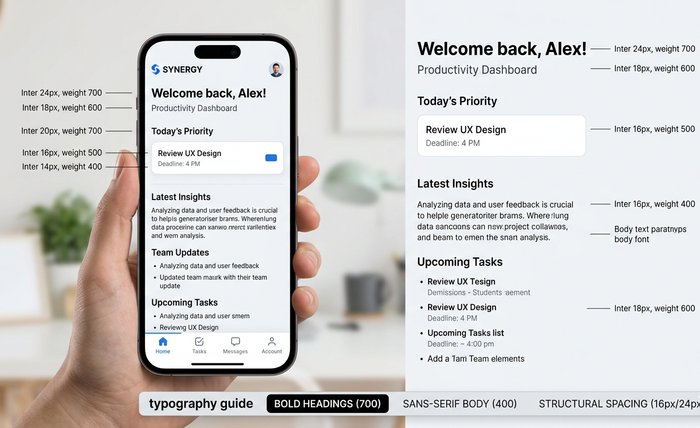
The Digital Interface Design is being redefined by how Modern Typography Approaches. The clarity of digital interfaces is life and death. An impressive application that has disordered typography irritates users. Even a basic site with well considered type-selections feels easy to use. Digital design typography is no longer a matter of choosing a pretty font; it is a field with practical implications that affect usability, accessibility and brand recognition. The development of modern typography in digital interfaces has been radically changed in the last ten years. Designers can now operate with variable fonts, fluid type scales and precision spacing systems that scale over hundreds of screen sizes. Such tools as opentype fonts have increased the range of what is technically possible and intelligent designers are cashing in. Print and digital typography are based on the same principles whereas they perform their activity under entirely different conditions. Print is fixed, a designer has a command over the appearance of text on a physical page, while digital is fluid, with text displaying on thousands of screens.
The clarity of digital interfaces is life and death. An impressive application that has disordered typography irritates users. Even a basic site with well considered type-selections feels easy to use. Digital design typography is no longer a matter of choosing a pretty font; it is a field with practical implications that affect usability, accessibility and brand recognition.
The development of modern typography in digital interfaces has been radically changed in the last ten years. Designers can now operate with variable fonts, fluid type scales and precision spacing systems that scale over hundreds of screen sizes. When you create, create or publish anything on the internet, you actually have a real advantage by knowing these methods. Such tools as opentype fonts have increased the range of what is technically possible and intelligent designers are cashing in.
Why Typography in Digital Interfaces Demands Its Own Approach?
Print and digital typography are based on the same principles whereas they perform their activity under entirely different conditions.
Print is fixed. A designer has a command over the appearance of text on a physical page. Digital is fluid. Text displays on thousands of device configurations the different screen sizes, resolutions, operating systems, browsers and ambient light conditions.
This implies that digital typography choices have additional variables. The same font can appear slim and pale on a midrange Android phone that is refined on a premium MacBook display. Modern typography solutions consider this variability at each phase of the design process.
Variable Fonts: One File, Infinite Flexibility
One of the biggest developments in digital typography in years is variable fonts. Only one variable font file has a complete range of weights, widths and styles all available in CSS without having to load a separate font file each.
Conventional font loading is achieved in such a way as Regular, Bold, Italic and Bold Italic are loaded as four distinct files. Variable fonts put everything in a single font and interpolate smoothly between any point on the scales.
The advantages are pragmatic and short term in the case of digital interfaces:
- Reduced loading time minimal HTTP requests and reduced overall file size
- Accurate control of weight not 400 and 700 but any 100 to 900.
- Responsive changes weight and width may change according to the screen size.
- Less gritty animated changes between type states.
Variable fonts do not only enhance performance. They provide designers with much greater expressiveness without performance cost.
Fluid Typography: Scaling Across Every Screen
Defined fonts do not work. The 48px headline appears dominating in a wide screen display. The same 48px headline on a 320px mobile display overcrowds the layout with clumsy line breaks.
CSS clamp() is a solution to this, and it uses a fluid value to scale between a minimum and maximum size based on viewport size, aligning with fluid typography.
The outcome: type scales smoothly on all devices without dozens of media query breakpoints. Text is comfortable on any size screen without requiring to be adjusted manually at each breakpoint.
The following is an example of a modern fluid type scale:
| Text Element | Min Size | Max Size | Behaviour |
|---|---|---|---|
| H1 Heading | 28px | 56px | Scales with viewport width |
| H2 Heading | 22px | 36px | Scales with viewport width |
| Body Text | 16px | 18px | Minimal scaling, prioritises readability |
| Caption / Label | 12px | 14px | Near-fixed and functional clarity |
| Button Text | 14px | 16px | Consistent across breakpoints |
This method is used to substitute the trial-and-error of manually adjusting font sizes to each breakpoint with a system that just works.
Typographic Hierarchy: Guiding Users Without Saying a Word
All digital interfaces convey priority using visual hierarchy. The main tool of creating such a hierarchy is typography.
Strong digital typographic hierarchy works on three levels:
- Macro level: H1 vs H2 vs body text. Distinct size and weight differences so that the users can know the contents structure at a glance.
- Micro level: distance between lines, paragraphs and sections. Regularity in rhythm that ensures one does not strain to read.
- Colour grade: not black on white alone. The slight tonal variations between the heading colour, body colour and secondary text are subtle enough to direct the focus without creating visual noise.
As the three levels are integrated and users get to navigate the content intuitively. Take out any of them and the interface begins to become disorienting even when the individual parts appear to be okay alone.
OpenType Features: The Hidden Power Inside Modern Fonts
A majority of designers are only utilizing a small portion of the capabilities of their fonts. The capabilities of OpenType are beyond the reach of most interfaces.
Ligatures automatically turn some combinations of characters into single more beautiful glyphs. Figures are available in a variety of styles, oldstyle figures are more compatible in running text and lining figures in tables and data displays. Contextual alternates are letterforms that replace themselves based on the context.
These features significantly affect the perceived quality and legibility in interfaces with a large amount of data such as dashboards, financial applications and analytics solutions, etc. An OpenType font with a good configuration appears deliberate and sophisticated in a data table. The default settings of the same data appear generic.
Accessibility and Inclusive Typography
The modern typography practices cannot disregard accessibility. Approximately 300 million individuals in the world have some kind of colour vision impairment and millions more are using the internet with low vision or reading problems such as dyslexia.
Digital typography has a couple of principles that cannot be compromised:
- Normal body text Minimum ratio of 4.5:1 between text and background.
- Body font at least 16px high smaller text causes users to have to zoom and those with low vision to be frustrated.
- Do not use justified text alignment and the spacing between the words is disrupted which makes reading difficult for people with dyslexia.
- A generous line height is 1.5x to 1.6x font size helps to improve readability across all users and cognitive differences users in particular.
- Always use colour to express meaning but weight, size and position should support it.
These are not restrictions on creativity. They are the foundation that makes sure that your interface is usable by as many people as possible.
Choosing the Right Typeface for Your Interface
The choice of typeface used in an interface presented digitally is not the same as branding or print work. The typography of interfaces is more functional than personal.
Before making a commitment to a typeface ask the following:
- Does it scale down to small on low resolution screens?
- Does it have the complete character set your content needs numbers, punctuation and any language specific characters?
- Is it varied enough in weight to construct an evident hierarchy?
- Is it embedded into web and app environments in the licence?
- What is its loading performance like if it has a variable font?
The correct typeface is one that hits all five tests and suits your brand image. The one that appears beautiful and does not perform or is illegible is not the one you want, however pleasing to the eye it appears in a vacuum.
Final Thoughts
Modern digital interface typography is a system rather than a style. Variable fonts, fluid type scales, OpenType features, typographic hierarchy and accessibility standards are collaborating to design interfaces that are polished, perform well and are useful to all users.
The designers and developers who consider typography to be a technical and not a visual art are able to create interfaces that are different. Every detail compounds. The use of spacing, weight, scale and contrast is what makes an interface look professional or amateurish, trustworthy or doubtful.
To those readers who like delving into the overlaps between creativity, productivity and digital craft, business discusses the type of practical, visionary content that enables independent creators and remote workers to work smarter, better and design with purpose.