

What Is Spanish “When”

Spanish “when” is cuándo (accented) interrogative word.
It helps you to ask questions about time, things, and conditions.
Not in question and in sentence, the accent falls off and it’s spelled as cuando.
Examples:
- ¿Cuándo llegas? (When are you arriving?)
So, cuándo is direct question and cuando is indirect or general time.
Pronunciation
Cuándo is pronounced KWAHN-doh.
Breakdown:
- Cuan → kwahn
- do → doh
Say it slowly: KWAHN-doh.
The cu is a “kw,” and the a is open and soft.
It is an easy and clear word to pronounce, and one hears it very often in spoken Spanish.
Grammar and Accent Difference
It is most crucial to notice the cuándo and the difference from cuando because an accent difference does matter.
- Cuándo (with accents): Question or exclamation form.
- Cuando (no accents): Statement form, “when something happens.”
Examples:
- ¿Llámame cuando llegues. (Call me when you arrive.)
- ¿Cuándo comemos? (When do we eat?)
Using Cuándo in Questions
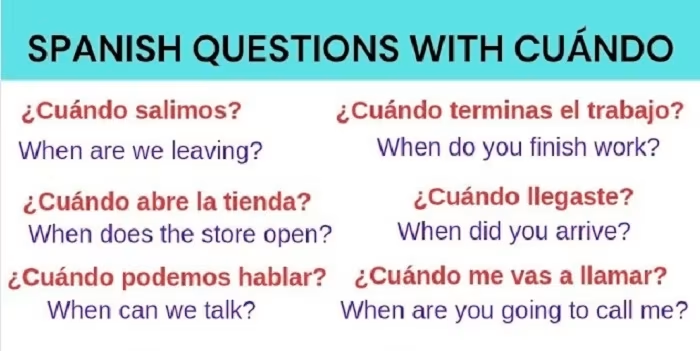
You use cuándo to construct any date or time question.
Your examples:
- ¿Cuándo es la fiesta? (When is the party?)
- ¿Cuándo comienza la película? (When does the movie start?)
- ¿Cuándo llegaste a casa? (When did you arrive home?)
- My brother: ¿Cuándo me vas a llamar? (When are you going to call me?)
- ¿Cuándo termina la clase? (When does the class end?)
Both formal and informal, both when you are calling your stranger, neighbor, or friend.
Use in Sentence
Alone unstressed cuando is also employed to connect the two halves of a sentence as well as the general feeling of when.
Examples:
- Llamaré de ahí. (I am going to call there.)
- Turn off the light when going out. (When going out, turn off the light.)
Some of the above are examples of how it can be used to express time, condition, and habit.
Cuándo vs. Cuando vs. Hasta
There are also some basic and overall words:
- ¿Desde cuándo? – Since when?
- ¿Hasta cuándo? – Until when?
Examples:
- ¿Hasta cuándo te quedas? (Until when do you stay?)
These sentences are used frequently in spoken and written English.
Cultural Note
It is usually employed most by the Spanish because, as they claim, it does sound horribly natural to use in time, planning, or action contexts. It is formal, handy, and respectful in either sense.
In Latin culture, because of the activity during the day to accommodate, cuándo is attached in temporal words like mañana (today), más tarde (later), or ahora (now) as a way of keeping the informal and relaxed sense.
- ¡Cuándo quieras, amigo! (Whenever you wish, friend!)
Examples in Daily Life
These are mere examples which you can use every time you speak on day-to-day occasions:
- ¿Cuándo sales del trabajo? (When do you get off work?)
- Llámame cuando llegues. (Call me when you arrive.)
- No sé cuándo empieza la reunión. (I don’t know when the meeting starts.)
They are short and easy to use on a daily basis when speaking Spanish.
Fascinating Cuándo Facts
- The Spanish word cuándo is from Latin primero quando and literally means “at what time.”
- The stress or intonation of the Spanish pronunciation cannot be heard but has more than one meaning when written.
- Cuándo alone can be a shortened question when the time has already been known beforehand.
Last Thoughts
Cuándo is actually the most simple and short Spanish word to learn. You can ask for the time, make plans, and schedule timetables. If you know this then your Spanish will be spontaneous.
So the next time you need to ask someone about the time or plan an event. Feel free to ask confidently.
FAQs
- Do I always go out of my way to place emphasis on the accent mark of an a in cuándo?
Only in question sentences. - Is there ever going to be a circumstance under which you would say the word when and it would never be a question?
Yes, in regular sentences it is “when”. - What does “cuando quieras” mean?
It is “whenever you want”.