

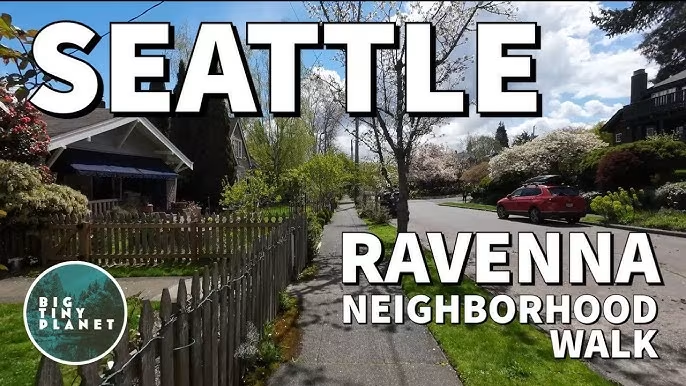
Finding a Seattle neighborhood that balances a strong financial return with a manageable commute feels nearly impossible for dual-income tech professionals. You want a peaceful community with great schools, but you refuse to spend two hours a day sitting in gridlock. This balancing act often forces buyers to compromise on either their daily quality of life or their property’s location.
Fortunately, one northeast Seattle enclave is completely defying the standard real estate trade-offs. As of May 2026, Ravenna home prices surged 11.5% year-over-year. This rapid, sustained growth pushed the neighborhood’s median sale price to an impressive $1.3 million.
Discovering Seattle’s “Neighbor-Wood”
The raw numbers clearly prove that Ravenna is a financial powerhouse in a shifting real estate landscape. However, understanding exactly why it holds such intense value requires looking closely at the tree-lined streets, the local schools, and the daily commute. You are not just buying a property line or an investment asset. You are investing in your family’s daily lifestyle.
Buyers are consistently drawn in by the area’s distinct architectural charm and the famous canopy of trees lining Ravenna Boulevard. The streets feature a beautiful, eclectic mix of cozy historic Tudors, classic Craftsman builds with deep front porches, and sleek new townhouses. If you are looking for an unfiltered look at these housing styles alongside the honest pros and cons of the area, you can explore this comprehensive living in Ravenna Seattle neighborhood guide. Analyzing the actual layout of the community makes it much easier to look past temporary listing trends and evaluate the long-term, quiet stability of these mature residential blocks.
Evaluating a $1.3 million investment requires cutting through typical real estate marketing jargon. You need hyper-local insights to understand the actual community vibe and what life looks like on a Tuesday evening in Ravenna Park. This ground-level perspective is how you confirm if the neighborhood truly fits your long-term needs.
Understanding Ravenna’s “Relative Value”
Navigating Seattle’s notoriously expensive housing landscape requires a deep understanding of “relative value.” This concept means looking beyond the initial sticker price to see what your money actually buys in terms of space, community, and future growth potential compared to similar areas. It is about finding the smartest place to park your capital.
Ravenna’s explosive success stands in stark contrast to the rest of the city. For example, the overall Seattle median home sale price decreased by 2.3% year-over-year down to $879,000 in May 2026. While the broader market cools and inventory sits longer, Ravenna remains incredibly hot with fast sale times.
Informed buyers are intentionally targeting Ravenna over ultra-expensive, traditional blue-chip neighborhoods like Queen Anne, Green Lake, or Capitol Hill. Those classic premium areas often come with significantly smaller lots, much higher price tags, and frustrating parking bottlenecks. Ravenna offers a quieter, leafier alternative with better square footage, without forcing you to sacrifice fast city access.
| Market Metric | Ravenna (May 2026) | Overall Seattle (May 2026) |
|---|---|---|
| Median Sale Price | $1.3 Million | $879,000 |
| YoY Price Growth | +11.5% | -2.3% |
| Market Dynamics | Lean inventory, intense buyer competition | Cooling prices, increased days on market |
| Neighborhood Vibe | Quiet, tree-lined “neighbor-wood” | Dense urban grid |
The Macro Drivers
You might wonder exactly how local infrastructure and institutional changes are padding your potential property value. Ravenna benefits massively from the “spillover growth” generated by the nearby University of Washington (UW) and the bustling University District. This proximity brings intense commercial vitality, a constant influx of highly paid academic talent, and strong population demand.
The expansion of the Link light rail into the northeast sector of Seattle has also fundamentally transformed the area. With stations readily accessible near the neighborhood borders, Ravenna is no longer viewed as an isolated, quiet enclave. It is now a highly accessible transit hub connecting residents rapidly to downtown, Capitol Hill, and the airport.
The Daily Grind: Commute Logistics for Tech Professionals
For many dual-income professionals, the ultimate deciding factor when buying a home is the reality of the daily drive. Navigating to major tech employers can drain your energy and steal hours from your week. Let’s look at the exact logistical details for residents heading to work from Ravenna.
If you commute downtown to the Amazon Spheres in South Lake Union, you face a mix of city streets and Interstate 5 options. For those heading east to the Microsoft campus in Redmond, the bridge-crossing realities across the SR 520 toll bridge are a major daily consideration.
Here is what you can expect for travel times during peak morning hours:
- To South Lake Union (Driving): Typically 15 to 25 minutes depending on the Interstate 5 Mercer Street exit traffic.
- To South Lake Union (Transit): Roughly 30 to 40 minutes using local bus routes or connecting to the light rail.
- To Redmond (Driving): Generally 25 to 35 minutes via the SR 520 toll bridge, assuming standard bridge flow.
- To Redmond (Transit): Approximately 45 to 55 minutes utilizing bus transfers across the lake.
Does the high price tag of a Ravenna home actually buy back valuable time in a tech professional’s day? Yes, the strategic location places you right in the middle of these two major employment hubs. It cuts down cross-city travel significantly compared to living further north in Shoreline or deep in West Seattle.
“Real Talk”: The Honest Downsides of a Ravenna Address
We need to provide a transparent, unfiltered assessment of the neighborhood’s actual limitations. The reality is that Ravenna is pricey, and sometimes it feels like you are not getting enough house for your money. Setting realistic financial expectations is absolutely necessary before you start touring open houses.
Next, we have to look closely at the transit infrastructure. While the system is highly functional, the bus lines connecting directly to the Amazon campuses are decent but not the absolute greatest. You will likely face a short walk in the rain or a route transfer rather than a true door-to-door shuttle experience.
Buyers also face the harsh realities of competing for a very limited housing stock. You will often have to choose between a charming but aging “fixer-upper” or paying a steep premium for a move-in-ready property. Renovating a 1920s Tudor comes with hidden costs, from updating old electrical wiring to fixing century-old foundation quirks.
Acknowledging these neighborhood downsides is a necessary step in making a confident, well-informed real estate investment. Perfection does not exist in the Seattle housing market. Knowing the exact trade-offs helps you buy a home without long-term regret.
Conclusion
Ravenna remains a highly profitable anomaly in the Seattle real estate market. Its unique blend of relative financial value, strategic infrastructure growth, and undeniable architectural charm makes it a standout choice. It continues to attract strategic buyers who want a true community feel located incredibly close to the city center.
Navigating a competitive housing landscape is much easier when you are armed with the facts. Having a transparent, data-driven local partner is your best defense against overpaying. Find an expert who knows the exact streets and trade-offs to help you make a winning investment in Ravenna.